





Chemnovatic’s Recommended Nicotine Regulatory Framework:
The Net Population Impact Framework
Improving net population impact through risk-proportionate, implementable and enforceable nicotine regulation
Chemnovatic’s Recommended Nicotine Regulatory Framework proposes a practical way to assess and design nicotine regulation around its overall impact on population health. It recognises that different product categories carry different risk profiles and that regulation should be evaluated not only by its intended objectives, but also by its real-world consequences, enforceability and ability to be implemented across the legal value chain.
Improving net population impact
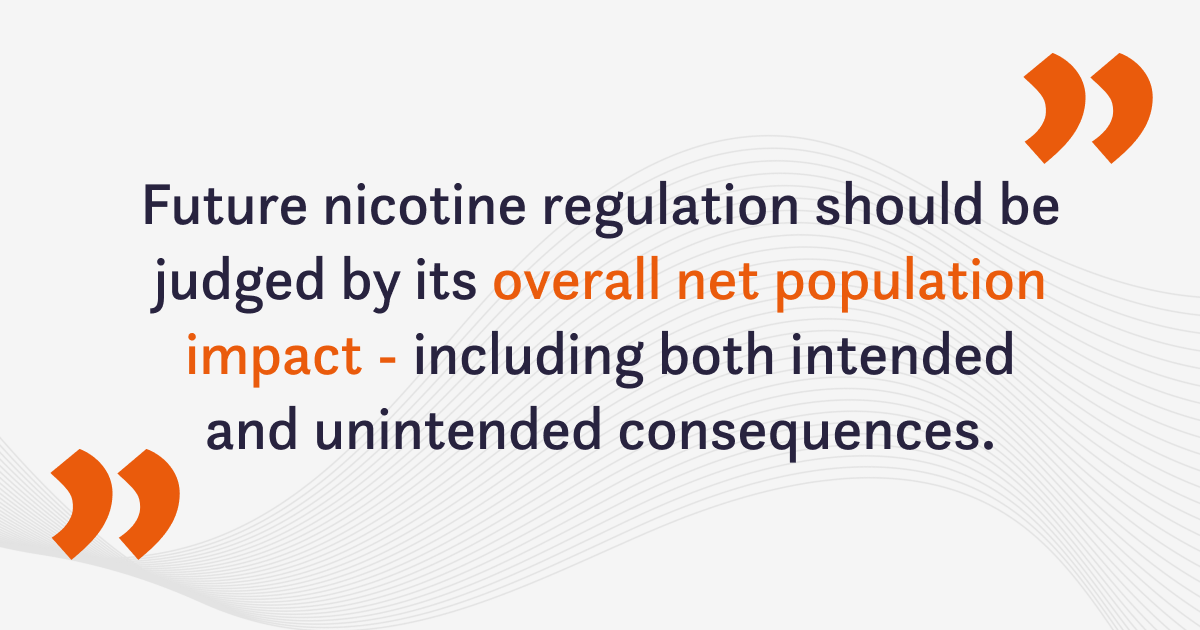
The framework is designed to improve the overall impact of nicotine regulation on population health by considering both its intended and unintended consequences.
Net population impact means the overall effect of regulation on population health after both its intended and unintended consequences are taken into account.
Five regulatory objectives
The framework aims to improve net population impact through: youth protection, adult switching support, smoking-related disease reduction, legal-market integrity and practical implementation.
Prevent youth initiation and protect non-users
Restricts underage access, youth-appealing presentation and unsafe or poorly documented products, without treating adult smokers and minors as one group.
Support adult smokers in switching away from combustible cigarettes
Keeps legal, adult-oriented alternatives available and understandable, while preventing youth-facing promotion and misleading claims.
Reduce smoking-related disease and deaths
Aligns regulatory burden with combustion risk and preserves incentives to move away from combustible cigarettes.
Maintain a legal, traceable and compliant market
Keeps demand inside legal channels that regulators can supervise, while making compliance operationally feasible for legitimate companies.
Limit illicit trade and avoidable legal-market disruption
Avoids price, availability or transition shocks that strengthen illegal supply, organised-crime incentives or avoidable SME disruption.
“Good nicotine regulation should be judged by what it achieves across the population, not simply by how restrictive it is.”
Seven components of the framework
These seven components translate the framework’s objectives into practical principles for regulatory design. They work together as one system, and several components contribute to more than one regulatory objective.
Combustible cigarettes, heated tobacco, e-cigarettes, nicotine pouches and medicinal nicotine should be differentiated by combustion, delivery route, tobacco content, evidence maturity, user group and enforcement profile. For nicotine itself, production route should not be used as a proxy for risk where chemical identity, purity and quality are equivalent; substances with materially different pharmacological or toxicological properties should be assessed separately.
Objectives supported:Age verification, underage-sales enforcement and restrictions on youth-appealing descriptors, youth-facing communication and digital promotion protect non-users without relying only on broad category bans.
Objectives supported:Adult smokers should retain access to regulated alternatives and accurate, non-misleading, age-gated information, while youth-facing promotion and unsubstantiated health claims remain prohibited.
Objectives supported:Toxicological review, product standards, batch consistency and documentation duties, supported by EU-CEG and other available data, should identify and prioritise risk. Controls should not default to exhaustive positive ingredient lists, broad functional prohibitions or formulation-level pre-authorisation without a demonstrated and proportionate safety justification.
Objectives supported:Fiscal differentiation from combustible cigarettes should be preserved where justified by risk and evidence. This does not mean an absence of taxation; it means avoiding tax design that unintentionally keeps cigarettes as the economically dominant nicotine product.
Objectives supported:Traceability and enforcement should target illegal operators, product authenticity risks, online and cross-border non-compliance and demonstrated traceability gaps. Requirements should be proportionate to the product and operator concerned, and unit-level traceability designed for finished tobacco products should not automatically extend to upstream B2B ingredients, formulations or mixtures.
Objectives supported:Realistic transition periods should cover reformulation, testing, notification and re-notification, packaging, stock management, supplier documentation and supply-chain adjustments, so that compliant operators can meet new requirements in practice.
Objectives supported:Every major regulatory option should pass three tests
Net-population-impact test
Assess effects on youth initiation, adult switching, smoking-related harm, legal-market viability and overall public-health outcomes.
Illicit-market and enforceability test
Assess whether the measure can be enforced and whether it may redirect demand towards illegal or untraceable channels.
SME and value-chain implementation test
Assess compliance costs, transition periods, reformulation, notification, packaging, logistics and wider supply-chain consequences.
Evidence basis for the framework
For each framework component, we show what the available evidence supports, what it does not prove, and what regulatory implication follows. This makes the reasoning behind the framework transparent and keeps its recommendations within the limits of the evidence.
Product-category and risk differentiation
Combustion is central to smoking-related disease. EU and international evidence also shows that non-combustible products are not risk-free and differ in evidence maturity.
It does not prove that nicotine is harmless or that all NGP categories have the same risk profile.
Rules should distinguish combustion risk, delivery route, tobacco content, product category and evidence maturity. For nicotine, regulatory treatment should be based on relevant chemical, pharmacological and toxicological characteristics rather than on production route alone, including whether nicotine is tobacco-derived or synthetic. Nicotine analogues or other nicotine-like substances with materially different properties should be assessed separately using evidence-based criteria and, where necessary, workable analytical methods.
Youth access and appeal controls
EU/JRC, SCHEER, Eurobarometer, CDC and other sources identify youth use, flavours, digital marketing and nicotine exposure as relevant concerns.
Youth risk does not prove that legal adult-oriented alternatives should be removed.
Youth protection should directly target access, appeal, marketing and enforcement rather than rely only on broad category bans.
Adult smoker switching and accurate age-gated information
Cochrane and NHS evidence supports the role of nicotine e-cigarettes for smoking cessation, while EU/JRC and SCHEER stress caution and the need for long-term evidence.
This does not justify use by minors, never-smokers or unlimited promotion.
Adult smokers should retain access to regulated alternatives and accurate age-gated information, with youth-facing promotion prohibited.
Draw only the regulatory conclusions the evidence supports.
Evidence should determine both the need for regulation and its limits. Regulatory measures should address demonstrated risks without assuming conclusions the evidence does not support.
Ingredient risk review and product quality standards
The TPD already uses safety, quality, labelling and notification requirements for e-cigarettes; EU-CEG captures ingredients, emissions and toxicological data.
This does not prove that every ingredient or presentation is acceptable.
Regulation should use toxicological review, product standards, batch consistency, documentation duties and, where evidence identifies a specific risk, targeted restrictions on named substances. EU-CEG and other available data should be used to identify and prioritise such risks. Controls should not default to exhaustive positive ingredient lists, broad functional prohibitions or formulation-level pre-authorisation without a demonstrated and proportionate safety justification.
Risk-proportionate fiscal treatment
EU tobacco taxation rules set harmonised minimum structures for manufactured tobacco and the Commission has proposed revising the framework in light of market developments.
Equal taxation of all nicotine products has not been shown to reduce net harm or prevent illegal supply.
Fiscal design should preserve incentives away from combustible cigarettes while maintaining youth safeguards and enforcement.
Legal-market traceability and enforcement
EU traceability systems and the 2026 illicit-trade analysis connect tobacco regulation with legal-market protection, state budgets and enforcement.
Prohibition or severe restriction does not eliminate demand by itself.
Major restrictions should be preceded by an illicit-market and enforceability assessment, including online and cross-border channels. Traceability and enforcement measures should address demonstrated gaps and be proportionate to the product and operator concerned, focusing on illegal supply, product authenticity and release-to-market documentation. Unit-level traceability designed for finished tobacco products should not be extended by default to upstream B2B ingredients, formulations or mixtures.
Implementable transition and value-chain design
Better Regulation requires assessment of feasibility, proportionality and burden; EU-CEG, TPD, traceability and tax systems show how compliance obligations interact operationally.
Implementation concerns do not mean regulation should be avoided.
Rules should include realistic transition periods and assess reformulation, testing, notification, packaging, stock losses, SME burden and supply-chain documentation.
Read the full paper
Net Population Impact Framework
The complete document presents the purpose, objectives, framework components, policy impact matrix, product-category analysis, cross-service implications and evidence basis for Chemnovatic’s regulatory approach.